
12.6 Shipbuilding and Engineering
Existing strengths in naval and commercial shipbuilding — particularly on the Clyde — and related engineering would be protected and expanded. Defence and civilian procurement would be used strategically to sustain high-skill employment and apprenticeships.

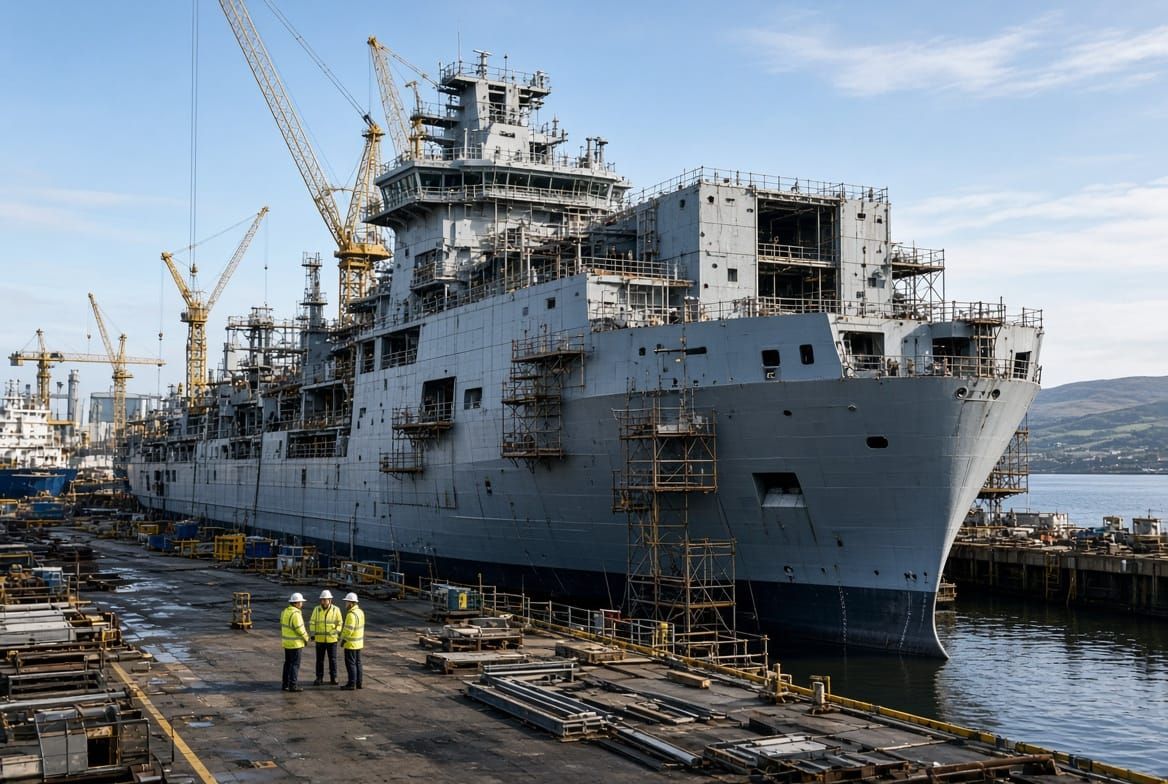
Existing strengths in naval and commercial shipbuilding — particularly on the Clyde — and related engineering would be protected and expanded. Defence and civilian procurement would be used strategically to sustain high-skill employment and apprenticeships. Scotland would seek continued participation in UK and international programmes where there is mutual benefit, while developing its own requirements and export opportunities. The industrial base is a national asset and would be treated as such.
Scotland retains significant capacity in naval shipbuilding, complex vessel construction and related engineering, with a major concentration on the Clyde. That capacity supports thousands of skilled jobs, sustains apprenticeships and technical expertise, and forms part of the wider advanced manufacturing economy. Independence would treat this industrial base as a national asset: protected, modernised, and expanded where strategic and economic logic supports it, not run down or left to residual market forces alone.
The same logic applies to related engineering capabilities that serve marine, energy, defence and industrial markets. Skills and facilities that took decades to build can be lost quickly; policy would be designed to retain and grow them. The main design choice is deliberate industrial policy that uses procurement, collaboration and selective investment to protect and expand a proven high-skill base. The main constraints are the fiscal cost of any support or investment, the commercial reality of competition for orders, dependence on negotiated participation in larger programmes, the time required to convert policy into sustained order books, and the need to align industrial capacity with the focused force structure and civilian marine demand already set out in the wider framework.
Scotland retains significant capacity in naval shipbuilding, complex vessel construction and related engineering, with a major concentration on the Clyde. That capacity supports thousands of skilled jobs, sustains apprenticeships and technical expertise, and forms part of the wider advanced manufacturing economy. Independence would treat this industrial base as a national asset: protected, modernised, and expanded where strategic and economic logic supports it, not run down or left to residual market forces alone. Skills and facilities that took decades to build can be lost quickly; policy would be designed to retain and grow them. Assets of this kind are path-dependent. Once critical mass of skills, facilities and supplier networks is lost, reconstruction is slow and expensive.
This section sets out the position. Existing strengths in naval and commercial shipbuilding — particularly on the Clyde — and related engineering would be protected and expanded. Defence and civilian procurement would be used strategically to sustain high-skill employment and apprenticeships, within value-for-money and capability requirements. Scotland would seek continued participation in UK and international programmes where mutual benefit exists, while developing its own naval and civilian vessel requirements and export opportunities. The industrial base would be treated as a national asset. Continuity of existing programmes and early clarity on Scottish requirements would protect skills and capacity through the transition. Selective expansion would focus on areas of genuine comparative advantage. The skills pipeline — apprenticeships, retention of experienced workers and knowledge transfer — would be linked to the order book. Deliberate policy would secure skills, orders, and long-term capability; the yards and the engineering base would be backed, not left to chance. That is the shipbuilding and engineering settlement.
Current Position and Legal/Institutional Baseline
Scotland’s shipbuilding and related engineering capacity is concentrated, skilled and hard to replace. The Clyde remains a centre for complex naval and specialist vessel work. Surrounding supply chains and engineering firms provide the depth that complex programmes require. Existing programmes and order books sustain high-skill employment and apprenticeships. Many complex programmes are collaborative, involving UK and international partners. Civilian demand includes ferries and other public vessels under Scottish competence. Defence demand is currently shaped within UK frameworks. Skills pipelines and technical education are linked to industry need but remain vulnerable to gaps in the order book. Long lead times for complex vessels mean that policy signals must be early and credible if investment and training decisions are to follow.
Independence would treat this base as a strategic national asset under full Scottish industrial strategy and procurement competence. The institutional baseline includes proven capacity, existing collaborative relationships, residual dependence on larger programme participation for volume of complex work, and clear links to the focused force structure, nuclear basing and civilian marine demand set out elsewhere in the framework. The task is to protect existing programmes and skills through transition; use defence and civilian procurement strategically within value-for-money rules; seek negotiated participation in UK and international programmes where mutual benefit exists; develop domestic requirements and export opportunities; and align the skills pipeline with the order book. International practice in jurisdictions that sustain specialised naval and marine industrial bases confirms that procurement design, collaborative participation, and skills policy must work together; market forces alone, or unlimited preservation without demand, are not sufficient.
Mechanism and Delivery
Scotland’s shipbuilding and related engineering capacity would be treated as a strategic national asset rather than a residual private-sector activity left entirely to market outcomes. The approach has two linked strands. Protection: the independence settlement, subsequent industrial strategy, and the deliberate use of public procurement would secure existing programmes, order books, and capabilities. Continuity of work on complex naval and commercial vessels, and on the engineering that supports them, would be prioritised so that skills and capacity are not lost during the transition. Protection is not a guarantee of every current job in perpetuity; it is a policy stance that treats the loss of critical capability as a strategic failure to be avoided. Expansion: where Scotland’s geography, skills and infrastructure give comparative advantage — in naval and specialist vessel construction, marine engineering and related advanced manufacturing — the base would be actively developed. That includes investment in facilities, skills and technology that serve both domestic requirements and export or collaborative opportunities. Expansion would be selective and capability-driven, not an attempt to recreate a full-spectrum heavy industrial sector regardless of demand. Selectivity is essential. Spreading limited resources across every possible segment would dilute capability; focusing on areas of genuine strength raises the chance of durable success.
Public procurement is one of the most powerful tools available to sustain and shape the industrial base. Defence procurement for Scottish naval and maritime requirements, and civilian procurement for ferries and other public vessels, would be used strategically to sustain high-skill employment and apprenticeship pipelines; anchor complex work in Scottish yards and engineering firms where they can compete on quality and value; and support the long-term viability of the industrial base that underpins both defence and civilian marine capability. Procurement would remain subject to value-for-money and capability requirements. The strategic use of procurement does not mean paying any price for any domestic outcome; it means designing requirements and competitions so Scottish industrial capacity has a fair and serious opportunity to win work it is competent to deliver. Procurement that ignores cost and performance destroys both industrial credibility and public value. Industrial strategy and procurement policy would sit under full Scottish competence. Scottish defence institutions would exercise defence procurement for Scottish forces, aligned with the force structure and NATO contribution already set out. Civilian vessel procurement (including ferries) would remain under Scottish transport and public procurement rules. State aid and subsidy control would follow the Scottish regime described in the trade and economic framework, within any applicable international commitments.
Many complex shipbuilding and engineering programmes are collaborative. Scotland would seek continued participation in UK and wider international programmes where there is mutual benefit. That could include workshare or supplier roles on programmes that already involve Scottish industry, and new collaborative projects in naval, specialist vessel or marine engineering domains. Participation would be negotiated on commercial and strategic grounds, not assumed as an automatic continuation of pre-independence arrangements. Where mutual interest exists, both sides gain from continuity of skilled capacity and supply chains. Where mutual interest does not exist, Scotland would not rely on sentiment; it would develop alternative demand and export routes. Participation in UK or international programmes would rest on negotiated agreements.
Alongside collaborative work, Scotland would develop its own naval and civilian vessel requirements to create demand for the domestic industrial base. It would support export opportunities for Scottish shipbuilding and engineering products and services. Export success depends on quality, cost and reputation; industrial policy would back those fundamentals rather than substitute for them. Sovereign capability in selected domains — especially complex naval and marine systems judged critical to national security and to the focused force structure — would be maintained or developed so that Scotland is not wholly dependent on external suppliers for key capabilities. Sovereign capability is selective; it is not a claim to autarky across the full spectrum of naval systems. The focused force structure and NATO contribution, including alignment with the NATO 5% path, generate domestic naval demand that the industrial base can serve. Ferry and marine infrastructure needs generate civilian vessel demand within the same industrial logic.
The industrial base is only as durable as the skills pipeline that feeds it. Policy would place explicit weight on sustaining and expanding apprenticeships and technical education linked to industry need; retaining experienced workers and transferring knowledge to the next generation; and the economic health of the communities where major shipbuilding and engineering sites are located. The sector treats high-skill employment and community viability as part of its strategic value, not secondary social outcomes. Order books without a skills pipeline produce short-term activity followed by capability loss; the design links both. Support for skills and apprenticeships would operate through Scottish education, training and industry bodies.
Sequencing prioritises continuity of existing work and skills through the transition: no abrupt cancellation of programmes that sustain critical capability; early clarity on Scottish defence and civilian vessel requirements so that industry can plan; active pursuit of collaborative opportunities where mutual benefit exists; phased investment in facilities and skills aligned with the order pipeline; and transparent metrics for employment, apprenticeships and capability retention. Complex shipbuilding has long lead times; policy signals must be early and credible if investment and training decisions are to follow.
Continuity Design
Continuity of existing programmes and skills is a design requirement. No abrupt cancellation of programmes that sustain critical capability; prioritisation of order continuity through the independence settlement and subsequent industrial strategy. Continuity of planning certainty for industry is supported by early clarity on Scottish defence and civilian vessel requirements. The government pursues continuity of collaborative opportunities through negotiation where mutual benefit exists. The skills pipeline is sustained through linked apprenticeship and training policy and measures to retain experienced workers and transfer knowledge. The design treats continuity of community viability around major sites as part of the sector's strategic value.
The design therefore treats loss of critical capability as a strategic failure to be avoided, treats procurement as a strategic tool within value-for-money rules, and treats selective expansion and skills policy as necessary complements to protecting the existing base. Deliberate policy secures skills, orders, and long-term capability; the yards and the engineering base are backed, not left to chance.
Constraints and Trade-offs
Legal constraints
Industrial strategy and procurement policy sit under full Scottish competence. Scottish defence institutions exercise defence procurement for Scottish forces, aligned with the force structure and NATO contribution. Civilian vessel procurement remains under Scottish transport and public procurement rules. Participation in UK or international programmes rests on negotiated agreements. Support for skills and apprenticeships operates through Scottish education, training and industry bodies. State aid and subsidy control follow the Scottish regime within applicable international commitments. Legal design must secure continuity of existing programmes through transition and clearly enforce value-for-money and capability requirements alongside strategic industrial objectives.
Fiscal constraints
Domestic naval and civilian vessel orders, facility support and skills programmes have costs. The Scottish budget pays, within the fiscal rules. Strategic procurement shifts public spending toward capability that also sustains industry; it does not eliminate the need to prioritise. Under the opening fiscal position, available resources constrain the scale of domestic orders and support. Industrial policy is not cost-free, and not every yard can be sustained regardless of orders. Selective expansion and sequencing with demand are necessary. Underestimating the cost of domestic demand or of skills investment would break the medium-term plan or leave capability unprotected.
Operational constraints
Complex shipbuilding has long lead times; policy signals must be early and credible. Sustaining high-skill employment depends on a credible pipeline of work — domestic, collaborative and export. Collaborative opportunities are negotiated, not automatic. Skills pipelines must match the order book; gaps produce capability loss. Facility investment must be sequenced with demand. Operational sequencing that prioritises continuity of existing programmes, early requirements clarity, active pursuit of collaboration and linked skills policy reduces the risk of skills attrition or order-book uncertainty. Under-estimating commercial competition or the time required to convert policy into sustained orders would leave the industrial base exposed.
Political constraints
The industrial base is high-visibility in the communities that depend on it. Programme continuity and early requirements clarity are essential to confidence through transition. Procurement that prioritises domestic placement without regard to cost and performance damages both value for money and industrial competitiveness. Over-reliance on collaborative programmes that may not materialise creates vulnerability. Domestic political management must present the industrial base as a national asset backed by strategic procurement within value-for-money rules, must pursue collaboration on mutual-benefit terms, and must link skills policy to the order book. Adversarial relations with the UK could reduce collaborative opportunities; they would not remove Scotland’s ability to place its own orders or to compete internationally. Contingency planning would require a stronger domestic and export focus if collaboration is constrained.
Time constraints
No abrupt cancellation of programmes that sustain critical capability at independence. Early clarity on Scottish defence and civilian vessel requirements is required so that industry can plan. Active pursuit of collaborative opportunities runs through the transition. Phased investment in facilities and skills is aligned with the order pipeline. Transparent metrics for employment, apprenticeships and capability retention support accountability. Long lead times mean that delayed requirements clarity freezes investment and training decisions. Staged continuity of existing work with early signalling of future demand is the operable path; abrupt programme loss or delayed clarity would damage the skills base.
Consistency with the Wider Framework
Shipbuilding and engineering policy sits alongside the defence industrial strategy and the long-term nuclear basing agreement that support naval and submarine-related activity; the focused Scottish force structure and NATO contribution that generate domestic naval demand; ferry and marine infrastructure needs that generate civilian vessel demand; the broader advanced manufacturing and skills agenda; and the overall treatment of strategic industrial capacity as a national asset. Industrial policy, defence policy and civilian marine requirements are designed to reinforce one another. There is no tension with the defence posture: the force structure and basing decisions create demand that the industrial base can serve. Alignment with the NATO 5% path reinforces the case for sustained naval and maritime capability and the industrial base that supports it. There is no tension with fiscal rules: procurement and support are explicit choices inside the plan. There is no tension with the non-EU trade stance: export and collaborative opportunities are pursued on independent terms.
The section aligns with the continuity-first approach applied throughout the framework: order and skills continuity through transition, early requirements clarity for those who must invest and train. It aligns with the partnership model of UK and international relations through negotiated participation where mutual benefit exists. In every case, the design subordinates unlimited preservation or purely commercial neglect to selective protection and expansion within value-for-money rules, and subordinates short-term placement to the long-term durability of skills and capability.
Hardest Critiques and Direct Responses
Feasibility
Protecting and selectively expanding an existing industrial base is feasible. Sustaining high-skill employment depends on a credible pipeline of work — domestic, collaborative and export. That pipeline is not automatic; it requires procurement design, negotiation and commercial performance. Facility and skills investment is feasible within fiscal limits and must be sequenced with demand. Feasibility fails if existing programmes are allowed to lapse without transitional protection, if requirements clarity is delayed, or if procurement ignores cost and performance and damages industrial credibility.
Cost and fiscal burden
Domestic naval and civilian vessel orders, facility support and skills programmes have costs. The Scottish budget pays, within fiscal rules. Strategic procurement shifts public spending toward capability that also sustains industry; it does not eliminate prioritisation. The framework does not claim that industrial policy is cost-free or that every capability can be sustained regardless of orders; it claims that the industrial base is treated as a national asset and backed by strategic procurement within value-for-money rules, skills policy and pursuit of collaborative and export work. Underestimating the need for a credible order pipeline or the cost of domestic demand would leave protection as rhetoric.
Dependence on agreement
Dependence on the United Kingdom is significant for participation in major UK programmes. It is lower for purely Scottish naval requirements, civilian ferries and export work. Adversarial relations could reduce collaborative opportunities; they would not remove Scotland’s ability to place its own orders or to compete internationally. Contingency planning would shift to a stronger domestic and export focus if collaboration is constrained. Negotiated participation remains the preferred route where mutual benefit exists; it is not assumed that pre-independence arrangements will continue automatically.
Transition risk
Order-book uncertainty, delayed clarity on Scottish requirements, and skills attrition if work pauses are material risks. Mitigation is continuity of existing programmes where possible, early publication of requirements direction, and active skills retention measures. Explicit value-for-money and capability tests mitigate residual procurement risk that prioritises placement over cost and performance. Parallel development of domestic demand and export capability mitigates the residual risk of over-reliance on collaborative programmes.
Alternatives (status quo and previous proposals)
Leaving the industrial base entirely to market forces would risk rapid capability loss in a sector characterised by long cycles and strategic value; it is rejected. Attempting to maintain a full-spectrum shipbuilding industry without regard to demand or cost would be fiscally and commercially unsustainable; it is rejected. Refusing collaboration on principle would shrink the available work; it is rejected. Treating the base as a national asset, using procurement strategically within value-for-money rules, seeking mutual-benefit collaboration, and developing domestic and export demand is the coherent design. Treating industrial support as unconstrained by fiscal rules or value-for-money is rejected as incompatible with the wider framework.
Political and public credibility
The claim most likely to be called unrealistic is that independence will automatically secure the yards and expand employment without hard choices on orders, cost and collaboration. The precise answer is that the industrial base is treated as a national asset and backed by strategic procurement, skills policy and pursuit of collaborative and export work; continuity of programmes and early requirements clarity are the transition mechanisms; value-for-money remains a constraint; and scale depends on the success of domestic demand and negotiated participation. Credibility is visible in order continuity, published requirements direction, apprenticeship numbers linked to industry, and honest accounting of the fiscal cost of support and domestic procurement. Readers who prefer pure market outcomes, unlimited preservation without demand, or refusal of collaboration on principle are invited to evaluate the framework through the lens of the path dependence of complex industrial capability and the need for a credible pipeline of work within fiscal and commercial constraints.
Position Summarised
Existing strengths in naval and commercial shipbuilding — particularly on the Clyde — and related engineering would be protected and expanded. Defence and civilian procurement would be used strategically to sustain high-skill employment and apprenticeships. Scotland would seek continued participation in UK and international programmes where mutual benefit exists, while developing its own requirements and export opportunities.
The industrial base is a national asset and would be treated as such. Deliberate policy secures skills, orders, and long-term capability; the yards and the engineering base are backed, not left to chance. That is the shipbuilding and engineering settlement. Continuity of existing programmes and early clarity on requirements protect skills through transition. Value-for-money and capability requirements remain constraints on procurement. Selective expansion focuses on areas of genuine strength. The skills pipeline is linked to the order book.
Conclusion
What would happen to shipbuilding and engineering? Existing strengths, especially on the Clyde, would be protected and selectively expanded. Defence and civilian procurement would be used strategically to sustain high-skill jobs and apprenticeships within value-for-money rules. Scotland would seek continued participation in UK and international programmes where there is mutual benefit. Scotland would develop its own requirements and export opportunities. The industrial base would be treated as a national asset.
The design meets the continuity test by prioritising order and skills continuity through transition, and meets the strategic test by linking industrial capacity to defence, civilian marine demand and export potential. The limit of the claim is clear: work depends on orders; orders depend on procurement choices, collaboration and commercial performance; fiscal resources are constrained; and selective expansion is required rather than unlimited preservation of every capability. The next sections turn to broadcasting, arts and culture, and sport.
Series Footer
This analysis forms part of People’s Future Scotland: The Independence Debate, a non-party framework examining the practical design of independence. Each section is written to withstand professional scrutiny and to prioritise mechanism, constraint and continuity over aspiration.