
4.8 Defence Industry and Procurement
Scotland would seek continued access to UK and NATO procurement programmes where there is mutual benefit, while developing its own requirements and export opportunities.

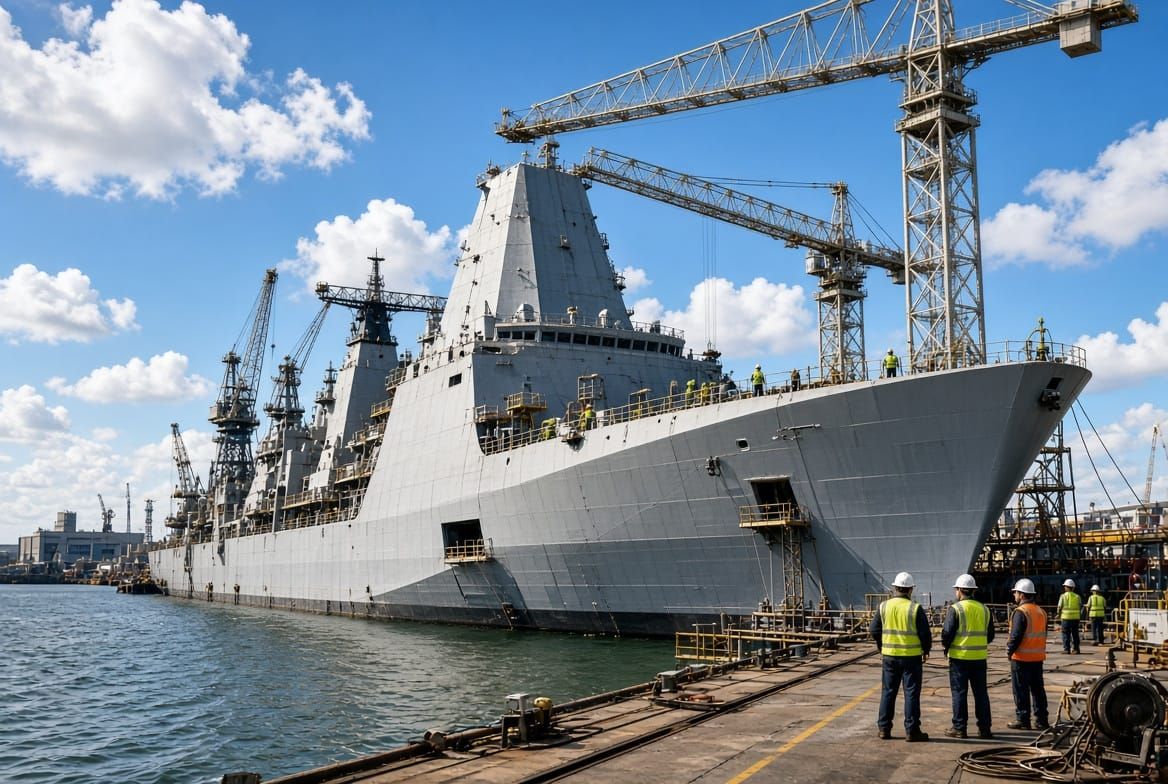
What would happen to the Scottish defence industry?
The existing defence industrial base—particularly naval shipbuilding on the Clyde, submarine support, and related high-skill supply chains—would be protected and expanded. Scotland would seek continued access to UK and NATO procurement programmes where there is mutual benefit, while developing its own requirements and export opportunities. Defence industrial strategy would prioritise skilled jobs, apprenticeships, and sovereign capability in key maritime and advanced technology areas.
Scotland already possesses significant defence industrial capacity: complex warship construction on the Clyde; submarine support and engineering linked to the nuclear deterrent and wider naval operations; and high-skill supply chains in engineering, systems integration, advanced manufacturing and specialised services. These activities support thousands of skilled jobs, sustain apprenticeships and technical expertise, and form part of the wider advanced manufacturing economy. They are national assets. Independence would treat them as such — to be retained, modernised and expanded where strategic and economic logic supports it, not run down or treated as residual UK activity.
The main design choice is a balanced procurement and industrial strategy: protect and grow priority maritime capability; use Scottish force demand and the nuclear basing partnership as anchors; seek continued UK and NATO programme access where mutual interest exists; and refuse both autarky and indifference to domestic capacity. The main constraints are the scale of Scottish domestic demand, dependence on collaborative programmes for complex systems, and fiscal discipline under a defence effort aligned with the NATO 5% plan. Continuity of work and skills through the transition is a design requirement; industrial capability lost in a gap year is expensive to rebuild.
Defence industry policy completes the defence and security design set out in this part of the framework. Forces, bases, intelligence, cyber resilience and Alliance membership all depend, in part, on whether Scotland retains and develops the industrial capacity to build, support and upgrade the systems those policies require — especially in the maritime domain. Scotland already possesses significant defence industrial capacity: complex warship construction on the Clyde, submarine support and engineering linked to the nuclear deterrent and wider naval operations, and high-skill supply chains in engineering, systems integration, advanced manufacturing and specialised services. These activities support thousands of skilled jobs, sustain apprenticeships and technical expertise, and form part of the wider advanced manufacturing economy. They are national assets. Independence would treat them as such — to be retained, modernised and expanded where strategic and economic logic supports it, not run down or treated as residual UK activity.
This section sets out the approach to protection and selective growth of the existing base, the balanced procurement strategy that values sovereign capacity in priority areas while remaining open to collaboration and competition, the pursuit of continued access to UK and NATO programmes where mutual benefit exists, the development of export opportunities, and the explicit weight given to skills, apprenticeships and the economic health of the communities that host major defence industrial sites. It does so without promising that every current contract continues unchanged, without claiming that Scottish force demand alone can sustain the entire industrial base, and without softening the dependence on collaborative programmes for the most complex systems. Continuity of critical work through the transition is a design requirement. Industrial capability lost in a gap year is expensive and slow to rebuild.
The design choice is deliberate balance. Autarky is unaffordable and unfocused. Indifference to domestic capacity would forfeit sovereign options and high-skill employment in the exact domain this framework treats as central to NATO contribution. The practical path protects the Clyde and related high-skill chains, grows where strategy and comparative advantage align, procures for effect with a fair opportunity for domestic industry, and negotiates continued programme roles on mutual interest.
Current Position and Legal/Institutional Baseline
Scotland hosts a concentrated and strategically significant defence industrial base. Naval shipbuilding and complex warship construction on the Clyde, centred on the yards at Govan and Scotstoun, form one of the most important remaining centres of surface warship capability in the United Kingdom. Submarine support and nuclear-related engineering linked to Faslane and Coulport sustain specialised skills and infrastructure that match the long-term nuclear basing agreement already set out. Surrounding supply chains in engineering, systems integration, advanced manufacturing and specialised services extend the employment and skills footprint well beyond the prime contractors. These activities are embedded in regional economies, particularly in the west of Scotland, and form part of the wider advanced manufacturing and engineering base.
Under the present constitutional arrangements, this industrial activity operates within UK defence procurement, industrial strategy and programme management. The Ministry of Defence places major contracts; UK frameworks manage collaborative programmes and export controls; and UK-wide and devolved education and industrial policies shape skills and apprenticeship pathways. Independence would change the legal and institutional baseline. Scotland would gain the capacity to run its own defence procurement and industrial strategy under Scottish law, set its own requirements, and negotiate participation in collaborative programmes as a sovereign partner. The physical capacity, skilled workforce, certified processes, and infrastructure would remain. The institutional task is to secure continuity of critical work through the settlement, establish Scottish procurement and industrial policy institutions, and align force demand, basing-related demand, and export effort so the industrial base has a viable order book over time.
The international baseline is the practice of small advanced states with significant defence industrial niches. Norway, Denmark, the Netherlands and others sustain specialised capacity in maritime, naval and related domains through a combination of national demand, collaborative programmes with larger allies, and export effort. They do not attempt full-spectrum autarky; they protect and grow the niches that match strategy and comparative advantage. Scotland would follow that model in the maritime and advanced naval domain where its existing base is strongest.
Mechanism and Delivery
The mechanism for protecting and growing the industrial base is a combination of settlement provisions that secure continuity of critical work, a Scottish defence industrial strategy that sets priorities and instruments, procurement rules that value sovereign capacity in priority areas while remaining open to competition and collaboration, and skills and regional policies that sustain the pipeline of apprenticeships and technical expertise.
Protection begins with the independence settlement. Continuity of work on complex naval platforms, submarine support and related activity would be prioritised so that skills and capacity are not lost during the transition. Where UK or collaborative contracts underpin that work, negotiated continuity or successor arrangements would be a settlement priority. Early political clarity that the Clyde and related capacity are strategic assets for an independent Scotland reduces the risk of order-book stalling, specialist outflow or investment freezes during the period of uncertainty.
Growth is selective and capability-driven. Where Scotland’s geography, skills and infrastructure give comparative advantage — especially in maritime, naval and northern-related capabilities — the industrial base would be actively developed through investment in facilities, skills and technology that support both Scottish force requirements and export or collaborative opportunities. A high national defence effort aligned with the NATO 5% plan increases the resources available to support industrial depth in priority areas; it does not justify industrial policy disconnected from force needs. Growth would not attempt to create a full-spectrum defence industry on a small-state scale.
Procurement policy would aim to deliver the required capability at acceptable cost and risk; support the Scottish industrial base where it can compete on quality and value; maintain interoperability with NATO Allies; and use competition and international collaboration where they improve outcomes. A purely “buy Scottish regardless of cost or performance” approach would damage both the forces and the industry's long-term health. A purely open international approach that ignored domestic capability would waste the industrial base that already exists. The practical path is a balanced strategy that values sovereign capacity in priority areas while remaining open to collaboration and competition. Value for money remains a requirement of the fiscal rules even inside a large defence envelope.
We would seek continued access to UK and NATO procurement and industrial programmes where there is mutual benefit. We would negotiate ongoing workshare or supplier roles on programmes that already involve Scottish industry, new collaborative projects in maritime, surveillance, or other relevant domains, and access to common standards, research, and technology initiatives within the Alliance on a commercial and strategic basis. Participation is not assumed as an automatic continuation of pre-independence arrangements. Where mutual interest exists — particularly in the naval and submarine support domain linked to the Clyde and the nuclear basing relationship — both sides gain from continuity of skilled supply chains. Where it does not, Scotland would adjust rather than pretend. The mutual-interest case still has to be written into contracts and agreements.
Export opportunities for Scottish defence and dual-use products and services, particularly in areas of existing strength, would be supported as part of diversifying demand. At the same time, Scotland would maintain or develop sovereign capability in selected domains judged critical to national security and the focused force structure—especially maritime and advanced naval systems. Sovereign capability does not mean autarky; it means retaining the ability to design, integrate, support or upgrade key systems without total dependence on external suppliers for every critical function.
Skills, apprenticeships and the economic health of the communities that host major defence industrial sites would receive explicit weight. These outcomes are not secondary social benefits; they are part of the industrial base's strategic value. A strategy that loses critical skills or hollows out local economies fails on both security and economic grounds. Alignment with education and regional policy is therefore part of delivery.
Continuity Design
Continuity of critical work and of the skills base is a design requirement. Industrial capability lost in a gap year is expensive and slow to rebuild. Settlement provisions, early political clarity on industrial priority, engagement with primes and SMEs, and sequenced Scottish procurement that signals demand would be used to prevent order books from stalling and specialists from leaving during the transition. Where UK or collaborative contracts underpin existing work, the independence settlement would prioritise negotiated continuity or successor arrangements.
Continuity of employment and training pathways would be supported by fair treatment of the existing workforce, by the maintenance of apprenticeship and technical education pipelines linked to industry need, and by the economic provisions already built into the nuclear basing agreement and wider base policy. Continuity of certification, quality and security standards required for collaborative and export work would be maintained through alignment with Allied and international norms rather than through abrupt divergence.
The design therefore treats industrial continuity as parallel to continuity of the nuclear basing mission, force personnel, and protective security. A gap in work or skills would undermine the maritime contribution model that the rest of the defence framework depends upon.
Constraints and Trade-offs
Legal constraints
Scottish procurement and industrial policy would operate under Scottish law, subject to international obligations arising from NATO membership, export controls and any collaborative programme agreements. Continuity of existing contracts through the settlement must be compatible with UK and Scottish legal frameworks and with the commercial terms of those contracts. Sovereign capability in selected domains requires the legal and regulatory capacity to design, certify and support systems to the required standards. These constraints are manageable through the legislative and treaty-making capacity already required by the wider framework, yet they require precise settlement language and timely institutional preparation.
Fiscal constraints
Industrial support, skills programmes and any premium for sovereign capacity in priority areas sit inside the defence budget and the wider fiscal framework. Inefficient subsidy without capability return would breach the spirit of the fiscal rules and the medium-term plan. The sector's employment and tax-base value is a real offset; it does not justify blank cheques. Under a defence effort aligned with the NATO 5% plan, there is greater capacity to support industrial depth in priority areas; governance must still ensure that industrial spending remains tied to force needs and to value for money. Scottish domestic demand alone will not sustain the entire existing base; over time, diversification through collaboration and exports is required.
Operational constraints
Complex naval and submarine support work depends on long-cycle skills, certified processes and specialised infrastructure that cannot be recreated quickly if lost. Continuity of work is therefore operationally critical. Collaborative programmes for the most complex systems will remain important; full indigenous development of every major platform is not feasible. Interoperability with NATO Allies requires adherence to common standards and, in many cases, participation in shared development or procurement. Skills pipelines take years to build; interruption damages both current capacity and future growth. The industrial base must support the focused force structure and the nuclear basing mission; industrial policy disconnected from those operational requirements would fail the readiness test.
Political constraints
Defence industrial decisions attract intense regional and political attention. Protection of Clyde capacity and related employment will be expected; delivery depends on negotiated continuity and on a viable order book over time, not on political declaration alone. Continued UK programme access is a matter of mutual interest and negotiation, not of entitlement. Export success depends on competitiveness and on the political and regulatory environment for defence exports. Sustaining a balanced strategy — neither autarky nor indifference — across electoral cycles requires consistent explanation of the link between industrial capacity, force effectiveness and Alliance contribution.
Time constraints
Settlement provisions on continuity of critical work must be secured early to prevent order-book stalling and specialist outflow. Scottish procurement institutions and the first signals of domestic demand must be ready to support the industrial base as transitional arrangements mature. Skills and apprenticeship pipelines operate on multi-year cycles; interruption creates gaps that cannot be closed quickly. Collaborative programme negotiations and export market development take time. A credibility gap between declared industrial priority and delayed continuity arrangements would itself generate the investment freezes and skills loss that the policy seeks to avoid.
Consistency with the Wider Framework
Defence industry strategy is the industrial counterpart of force structure, base policy, nuclear hosting and NATO contribution under a high national defence effort. The specialised maritime and northern focus of the armed forces creates demand for the exact capabilities in which the Clyde and related supply chains are strongest. The long-term nuclear basing agreement creates a sustained requirement for submarine support and related engineering that anchors part of the industrial base. Alliance membership and the 5% effort path increase the resources available to support industrial depth while still requiring spending to remain tied to readiness and value for money.
The strategy supports the fiscal base through high-value employment and tax contribution and is constrained by the same fiscal rules as other spending. It aligns with energy and maritime economic strengths and with the partnership model of UK relations: mutual interest in unique capacity is a negotiating asset, not a residual claim. It does not depend on EU membership. Constitutional continuity supplies the legal capacity to run procurement and industrial policy; the settlement must secure transitional work where possible. Continuity of skills and community economic activity aligns with the wider continuity design for regional economies and high-skill employment. In every case, the industrial base is treated as a strategic asset that underpins the rest of the defence package rather than as a residual or purely commercial sector.
Hardest Critiques and Direct Responses
Feasibility
Protecting existing capacity is feasible if contracts and settlement terms provide continuity of work. Growth in priority niches is feasible over a multi-year horizon if force procurement, basing-related demand and export effort align. Creating a broad indigenous industry across all domains is not feasible and is not attempted. Other small advanced states sustain specialised defence industrial capacity through the same combination of national demand, collaboration and exports. Feasibility falls only if continuity of critical work is neglected during the transition, if industrial policy is disconnected from force needs, or if mutual-interest collaboration is treated as automatic rather than negotiated.
Cost and fiscal burden
Industrial support, skills programmes and any premium for sovereign capacity in priority areas are real claims on the defence budget and the wider fiscal framework. Inefficient subsidy without capability return would breach the spirit of the fiscal rules. The sector's employment and tax-base value is a genuine offset that supports the medium-term fiscal plan; it does not justify blank cheques or retaining capacity that cannot compete on quality and value. Under a 5% path there is greater capacity to support industrial depth; governance must still tie spending to readiness and to the focused force structure. The alternative cost of allowing the Clyde and related capacity to run down — loss of skills, sovereign options and high-value employment — is substantial and long-lasting.
Dependence on agreement
Dependence on the United Kingdom is high for legacy programmes, some certification pathways and collaborative projects. Mutual interest in Clyde and submarine support capacity, reinforced by the nuclear basing relationship, is a negotiating asset. Adversarial exclusion from programmes would force faster diversification toward other Allied markets and toward Scottish force demand; short-term disruption risk would remain. Contingency planning for programme loss is part of industrial strategy. Participation in UK and NATO programmes is sought where mutual benefit exists and is negotiated on a commercial and strategic basis; it is not assumed as an entitlement of independence.
Transition risk
Order books stalling, specialist outflow or investment freezes during the period of uncertainty are material risks. Mitigation is early political clarity on industrial priority, settlement language on continuity of critical work, structured engagement with primes and SMEs, and sequenced Scottish procurement that signals domestic demand as transitional arrangements mature. A further risk is the loss of apprenticeship and skills pipelines; alignment with education and regional policy and the explicit weighting of skills in industrial strategy reduce that risk. Industrial capability lost in a gap year is expensive to rebuild; continuity is therefore a first-order design requirement.
Alternatives (status quo and previous proposals)
Allowing the Clyde and related capacity to run down destroys skills and weakens the maritime contribution model; it is rejected. A “buy Scottish only, regardless of performance or cost” approach harms force effectiveness and long-term industrial competitiveness; it is rejected. Ignoring domestic industry and buying solely on open international competition forfeits sovereign options and regional high-skill employment in priority domains; it is rejected as a complete approach. Attempting full-spectrum autarky is unaffordable and unfocused; it is rejected. The design prioritises protecting existing priority capacity, selective growth where strategy and comparative advantage align, balanced procurement, negotiated collaboration on mutual interests, and explicit weight on skills and communities.
Political and public credibility
The claim most likely to be called unrealistic is that the UK would continue to place complex naval work in an independent Scotland, or that Scottish force demand alone can sustain the industrial base. The precise answer is that mutual interest in unique capacity and in the nuclear basing support ecosystem makes continued collaboration rational, but not automatic — it must be negotiated into contracts and agreements; that Scottish demand, exports and other Allied work must diversify the order book over time; and that protection-and-growth is a strategy, not a guarantee of every current job in perpetuity. Credibility is measured by continuity of critical programmes, apprenticeship volumes, export wins and the alignment of industrial capacity with force readiness — observable outcomes, not declarations. Readers who prefer rundown, autarky or pure open competition are invited to evaluate the framework on those clear alternatives.
Position Summarised
Scotland’s existing defence industrial base, especially naval shipbuilding on the Clyde, submarine support and related high-skill supply chains, would be protected and grown. Procurement would support Scottish force requirements while seeking continued participation in UK and NATO programmes where there is mutual benefit. The strategy would prioritise skilled jobs, apprenticeships and sovereign capability in key maritime and advanced technology areas.
Industry is treated as a strategic asset that underpins both national security and high-value employment. Capability, skills and long-term industrial strength would guide decisions, not short-term political symbolism. Continuity of critical work through the transition is required; diversification of demand through collaboration and exports over time is expected. The approach refuses both autarky and indifference to domestic capacity. Under a defence effort aligned with the NATO 5% plan, more resources will support industrial depth in priority areas; that support remains subject to value for money and the readiness requirements of the focused force structure.
Conclusion
Defence industry policy completes the defence and security part of this framework. Forces, bases, intelligence, cyber resilience and Alliance membership all depend, in part, on whether Scotland retains and develops the industrial capacity to build, support and upgrade the systems those policies require — especially in the maritime domain.
The position is deliberate: protect the Clyde and related high-skill chains; grow where strategy and comparative advantage align; procure for effect with a fair opportunity for domestic industry; negotiate continued UK and NATO programme roles on mutual interest; and treat skills and communities as strategic, not incidental. That is not a promise that every contract continues unchanged. It is a strategy for keeping a national asset in the service of a northern maritime Ally that funds defence seriously and expects industry to deliver capability in return.
Together with the preceding sections, this closes the Defence, Security and NATO part of the framework: host the deterrent under treaty; join NATO as a high-effort equal Ally; field focused forces; keep and develop the bases; build integrated intelligence and cyber capacity; and sustain the industrial base that makes the rest possible. The next parts of the Independence Debate turn from security to the economic, constitutional and social design of the independent state.
Series Footer
This analysis forms part of People’s Future Scotland: The Independence Debate, a non-party framework examining the practical design of independence. Each section is written to withstand professional scrutiny and to prioritise mechanism, constraint and continuity over aspiration.