5.2 Goods Border Arrangements
Goods moving between Scotland and the rest of the UK would be managed through a combination of mutual recognition of standards where possible, a trusted-trader scheme for most commercial volume, digital pre-clearance, and risk-based, intelligence-led checks.
What arrangements would apply to the movement of goods?
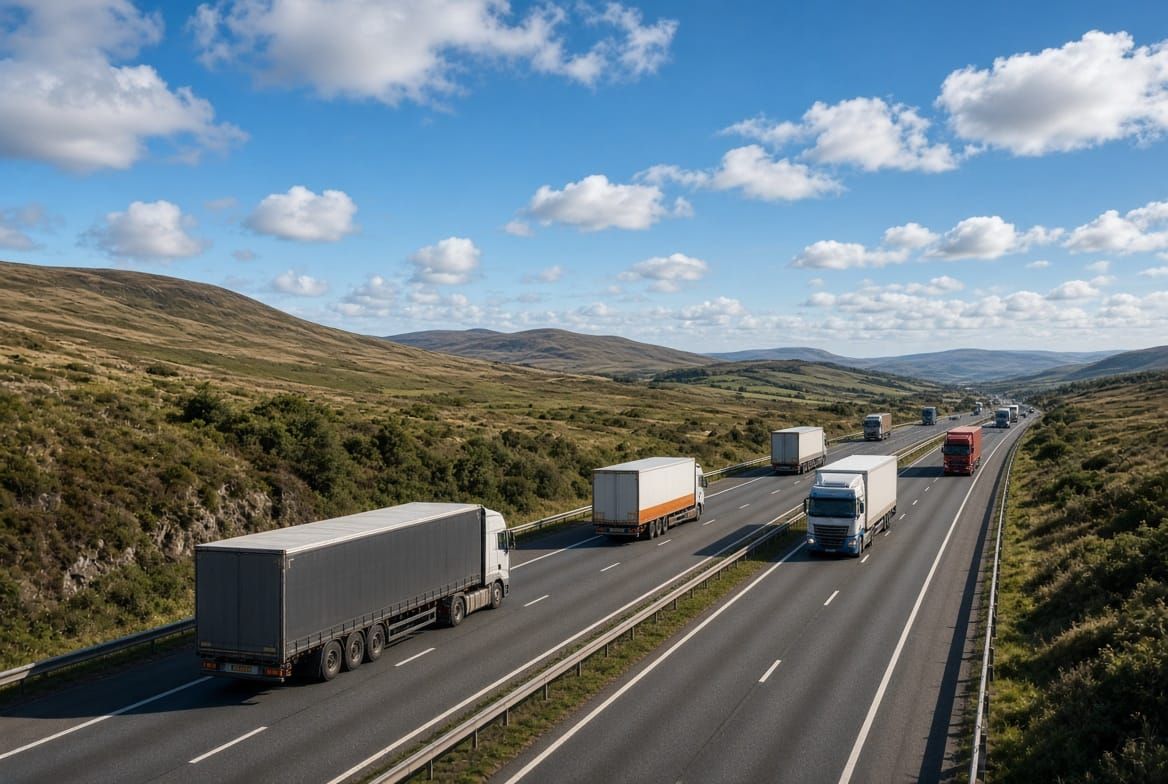
Most legitimate trade would have no traditional hard border, physical infrastructure, or routine stops. Goods moving between Scotland and the rest of the UK would be managed through a combination of mutual recognition of standards where possible, a trusted-trader scheme for most commercial volume, digital pre-clearance, and risk-based, intelligence-led checks. Some administrative friction is inevitable if regulatory rules diverge, but the system would be designed to keep costs and delays to a minimum for compliant businesses. Technology and data-sharing would be prioritised over physical barriers.
The rest of the UK is, by a wide margin, Scotland’s dominant market for goods. Integrated supply chains cross the border repeatedly. A conventional hard border — permanent infrastructure, routine stops, systematic physical checks — would raise costs, slow deliveries and damage firms on both sides. That outcome is rejected. The absence of routine physical infrastructure does not mean the absence of rules; it means rules are enforced through systems, authorised traders and targeted intervention rather than through a line of barriers across every road and rail link.
The main design choice is a modern, risk-based border management model paired with a pragmatic stance on regulatory alignment: align where divergence would create serious trade costs; diverge where Scottish policy requires it, accepting residual process. The main constraints are UK agreement on mutual recognition and data-sharing, administrative capacity to run trusted-trader and pre-clearance systems, and the honest trade-off between regulatory freedom and friction. Continuity for compliant commercial traffic is the design test.
The rest of the United Kingdom is, by a wide margin, Scotland’s dominant market for goods. Integrated supply chains cross the Scotland–England border repeatedly. Just-in-time logistics, multi-site manufacturing and the daily movement of food, components and finished products all depend on low-friction passage. A conventional hard border — permanent physical infrastructure, routine stops and systematic checks on every significant movement — would raise costs, slow deliveries and damage firms on both sides of the line. That outcome is rejected. The absence of routine physical infrastructure does not mean the absence of rules. It means rules are enforced through systems, authorised traders and targeted intervention rather than through a line of barriers across every road and rail link.
This section sets out the practical arrangements for moving goods. The toolkit combines mutual recognition of standards where possible, a trusted-trader scheme covering most commercial volume, digital pre-clearance of consignments, and risk-based, intelligence-led checks. The toolkit prioritises technology and data-sharing over physical barriers. The design is honest about residual administrative friction where regulatory rules diverge: divergence is a sovereign choice that brings both benefits and costs, and the border system would be built to minimise those costs for compliant businesses rather than pretend they do not exist. Continuity for legitimate commercial traffic is the design test. If the settlement forces routine physical intervention on most compliant trade, it has failed this part of the framework.
The approach sits alongside free movement of people under a Common Travel Area-style model and full Scottish control of immigration from outside that zone. The overall package keeps people movement open and goods movement as frictionless as possible within the constraints of regulatory choice, using modern methods rather than a traditional hard border.
Current Position and Legal/Institutional Baseline
Under the present constitutional arrangements, there is no international customs or regulatory border between Scotland and the rest of the United Kingdom. Goods move under a single internal market, a single customs territory and common product standards. There are no routine customs declarations, origin checks, or systematic sanitary and phytosanitary (SPS) controls on movements within the UK. Integrated supply chains operate as domestic logistics.
Independence would create an international border for goods. The legal baseline would shift from internal movement to arrangements that manage the interface between two customs and regulatory territories while preserving as much continuity as possible for legitimate trade. The institutional task is to design and implement a modern, risk-based system that avoids traditional hard-border infrastructure for most compliant volume, while retaining the ability to enforce standards and intervene on risk.
International practice supplies the relevant tools. Advanced border systems increasingly rely on authorised-trader or trusted-trader programmes, advance electronic declarations, automated risk analysis and mutual recognition or equivalence arrangements for standards. Physical intervention is concentrated on higher-risk or unknown movements. The Scotland–rUK border would use the same toolkit, adapted to volume, integrated supply chains, and the political requirement to avoid a visible hard border that damages the dominant trading relationship.
Mechanism and Delivery
The mechanism is a goods cooperation agreement negotiated as part of the independence settlement and implemented through reciprocal legislation, operational protocols and shared or interoperable digital systems. The agreement would establish the legal basis for mutual recognition or equivalence of standards in agreed sectors, the criteria and process for trusted-trader authorisation, the requirements for digital pre-clearance, the gateways for data-sharing and risk analysis, and the framework for risk-based intervention.
Mutual recognition of standards would be pursued where Scotland and the rest of the UK maintain equivalent or compatible rules for product safety, technical regulations and related requirements. Goods that comply on one side would be accepted on the other without additional checks. The more regulatory alignment is preserved in high-volume sectors — food, chemicals, key manufactures — the less friction arises. Mutual recognition is a negotiated and maintained outcome, not an automatic permanent state. Where Scotland chooses to diverge for legitimate policy reasons, additional process becomes unavoidable; the system would still use technology and trusted-trader status to reduce that process for compliant operators.
Trusted-trader schemes would authorise businesses that meet defined standards of compliance, record-keeping and supply-chain security to move goods with minimal intervention. The bulk of commercial volume would be expected to move under such schemes, concentrating official attention on higher-risk or unknown traders. Accreditation would be based on clear criteria, subject to audit and revocation for non-compliance. Existing compliant operators would be given a pathway to early authorisation so that the transition does not create a sudden cliff for firms that already meet high standards.
Digital pre-clearance would require advance electronic declaration of consignments, allowing risk assessment before goods move. Compliant, pre-cleared loads would proceed with little or no delay. Systems interoperability and legal gateways for data use between Scottish and rUK authorities would be essential. Investment in digital infrastructure and in businesses' capacity — especially smaller firms — to use the systems would form part of the transition design.
Risk-based, intelligence-led checks would target physical or documentary intervention based on risk and intelligence rather than routine application to all movements. This keeps the system focused on genuine compliance and security concerns and aligns with the intelligence and security cooperation already required by the wider framework. Serious risk is better managed through intelligence and authorised-trader accountability than through stopping every lorry.
Implementation would prioritise high-volume sectors and corridors, provide adequate transition time and support for business adaptation, and publish draft models early so that uncertainty itself does not become a cost. A phased introduction, provisional recognition of existing compliant operators, and early technical talks parallel to political negotiation would reduce transition risk.
Continuity Design
Continuity for compliant commercial traffic is the design test. Integrated supply chains that currently operate as domestic logistics must be able to continue with minimal additional process. Early clarity on the rules, provisional recognition of existing trusted operators, prioritisation of high-volume corridors and support for businesses to adapt to digital and trusted-trader requirements would all form part of practical implementation. Uncertainty during negotiation is itself a cost; published draft models and phased introduction reduce that cost.
Early mutual-recognition or equivalence arrangements would secure continuity of standards recognition in high-volume sectors, with alignment maintained. Legal gateways and operational protocols would secure continuity of data and risk-analysis cooperation, coming into force on Independence Day or under provisional application. The risk-based model itself would secure continuity of enforcement capacity: authorities would retain the ability to intervene where necessary without imposing routine stops on most legitimate trade.
The design therefore treats goods continuity as parallel to the free movement of people and the wider continuity choices for sterling, contracts, and public services. A settlement that preserved those other continuities while imposing a traditional hard goods border would be incoherent and would fail the test of the dominant trading relationship.
Constraints and Trade-offs
Legal constraints
Mutual recognition, trusted-trader status, digital pre-clearance and data-sharing all require legal gateways in both jurisdictions. Unilateral Scottish systems cannot compel recognition or data exchange by rUK authorities. The goods cooperation agreement must therefore create clear, enforceable rights and duties. SPS rules for agri-food, product safety regimes and customs procedures must be coordinated so that gaps or overlaps do not create unintended barriers or enforcement vacuums. Divergence in standards is a sovereign right; the legal consequence is a residual process that the system can mitigate but not eliminate.
Fiscal constraints
IT systems, customs and standards administration, trusted-trader accreditation and business compliance support are real public costs that sit in border and regulatory budgets within the fiscal framework. Private costs fall on traders, especially smaller firms adapting to new declarations and record-keeping. Those costs are lower than the economic damage of a hard infrastructure border but are not zero. Support for SME adaptation is part of transition design. Under the opening fiscal position, border administration competes with other claims; prioritising digital and trusted-trader tools over physical infrastructure is the efficient choice, but it still requires sustained funding.
Operational constraints
Systems interoperability, data quality, accreditation capacity and the ability to conduct risk-based interventions all require operational readiness. Agri-food and SPS movements present particular technical challenges that require specific protocols rather than generic customs processes. High-volume just-in-time supply chains are sensitive to even small delays; the system must be designed and tested against those realities. Business onboarding, especially for smaller firms, takes time and support. Continuity of enforcement expertise and of cooperation with rUK counterparts is required if risk-based targeting is to be effective from day one.
Political constraints
A low-friction goods border depends on UK agreement on mutual recognition, data-sharing and reciprocal trusted-trader treatment. Without that cooperation, Scotland can still avoid building a hard physical border on its own side and can run its own risk-based systems, but friction would rise, and duplicate processes would appear. Negotiation of a goods cooperation agreement is therefore a core settlement task, aligned with the priority given to the rUK market. Domestically, the honest trade-off between regulatory divergence and residual friction must be explained; divergence is a choice that carries cost as well as benefit. Sustaining the arrangement requires visible operational success and business confidence.
Time constraints
Legal text, systems readiness, business onboarding, and operational protocols must advance far enough that Independence Day does not impose full declarations without preparation. A phased introduction, provisional recognition of existing compliant operators, and early technical talks parallel to political negotiation are required. Agri-food and high-volume manufacturing corridors need particular attention because disruption costs are concentrated and visible. Uncertainty that extends deep into the transition itself becomes a cost to investment and supply-chain planning.
Consistency with the Wider Framework
Goods arrangements implement the trade priority on the rUK market and the regulatory alignment-versus-divergence rule set out in the wider trade framework. They complement free movement of people under the Common Travel Area-style model: no hard people border, and no traditional hard goods border for most legitimate trade. They support energy and industrial supply chains that cross the border, and that underpin both the fiscal base and the defence-industrial capacity already described. They sit within fiscal realism about administrative cost and align with the non-EU stance: the model does not require Single Market participation or customs-union membership with the EU. Intelligence-led checks align with the Scottish Intelligence and Security Service and with risk-based enforcement across the security framework. In every case, the design keeps the dominant trading relationship as frictionless as regulatory choice allows, using modern tools rather than twentieth-century infrastructure.
Hardest Critiques and Direct Responses
Feasibility
Risk-based, digital and trusted-trader models are already used in advanced border systems worldwide. Implementing them on the Scotland–rUK border is feasible if both sides invest in systems, legal gateways and business onboarding. It is not feasible as a zero-friction outcome under full regulatory divergence; residual process is acknowledged and mitigated rather than denied. Feasibility falls away only if the UK withholds cooperation on mutual recognition and data-sharing, if systems are left unready, or if business support is neglected so smaller firms cannot access trusted-trader status.
Cost and fiscal burden
Public costs for IT, administration and accreditation, and private costs for compliance and adaptation are real. They are lower than the economic damage of a traditional hard border with routine physical checks, but not zero. Support for SME adaptation is a necessary transition expenditure. Under the fiscal framework, these costs sit in border and regulatory budgets and compete with other claims; prioritisation of digital tools over physical infrastructure is the efficient choice. The higher cost of not securing a low-friction arrangement would fall on firms, supply chains and the wider economy through delays, duplicated processes and lost investment.
Dependence on agreement
Dependence on the United Kingdom is high for mutual recognition, data-sharing and reciprocal trusted-trader treatment. Without UK cooperation, Scotland can still avoid building a hard physical border on its own side and can operate its own risk-based systems, but friction would rise, and duplicate processes would appear. Negotiation of a goods cooperation agreement is therefore a core settlement task. Both sides have a strong economic interest in continued low-friction trade; the negotiation task is to convert that interest into durable legal and operational arrangements.
Transition risk
Sudden imposition of full declarations without systems readiness, exclusion of legitimate traders from trusted schemes, or gaps in SPS handling for agri-food are material risks. Mitigation is phased introduction, provisional recognition of existing compliant operators, prioritisation of high-volume corridors, early technical talks parallel to political negotiation, and published draft models that give business time to adapt. Uncertainty itself is a cost; reducing the transition's duration and opacity is part of the design.
Alternatives (status quo and previous proposals)
A traditional hard border with routine physical checks imposes high economic and social cost and is rejected. A claim of zero friction under any degree of regulatory divergence is not credible and is rejected in favour of honest residual process plus mitigation tools. Full customs union or automatic dynamic alignment with the rest of the UK as the only option would constrain regulatory sovereignty beyond this framework’s design; it is not required for a low-friction model, because mutual recognition and trusted traders can deliver most of the benefit where alignment is chosen sector by sector. No formal goods arrangement relying only on goodwill leaves firms without legal certainty and is rejected. The design chooses modern, risk-based management, mutual recognition where possible, trusted traders for bulk volume, digital pre-clearance and targeted intervention.
Political and public credibility
The claim most likely to be called unrealistic is that a low-friction goods border is possible without a hard border or without surrendering regulatory control, or that technology alone solves agri-food and standards checks. The precise answer is that low friction depends on negotiated mutual recognition, trusted-trader coverage of most volume and digital pre-clearance — all standard tools of modern border management — and that divergence still carries residual cost, which this framework admits rather than denies. Technology reduces friction; it does not abolish the need for legal agreements and operational capacity. Credibility is measured by published procedures, onboarding rates for trusted traders, measured border times and business experience of continuity — not by slogans about “no border.” Readers who prefer a hard border or who demand zero friction under full divergence are invited to evaluate the framework on those clear alternatives.
Position Summarised
There would be no traditional hard border, physical infrastructure, or routine stops for most legitimate trade. Goods moving between Scotland and the rest of the UK would be managed through mutual recognition of standards where possible, trusted-trader schemes covering most commercial volume, digital pre-clearance, and risk-based, intelligence-led checks. Some administrative friction is inevitable if regulatory rules diverge; the system would be built to keep that friction to a minimum for compliant businesses.
Technology and data-sharing would be prioritised over physical barriers. The aim is practical continuity of trade across the border while preserving Scotland’s ability to set its own rules. Friction is minimised; control is not abandoned. UK cooperation on mutual recognition, data-sharing and reciprocal trusted-trader treatment is required for the fullest effect and would be a core negotiation objective. Continuity for compliant commercial traffic is the design test.
Conclusion
Goods movement between Scotland and the rest of the UK should not be forced into a twentieth-century hard border to prove sovereignty. Sovereignty is exercised in the power to set rules and to enforce them through modern, risk-based systems. This framework therefore rejects routine physical infrastructure for most legitimate trade, invests in mutual recognition, trusted traders and digital pre-clearance, and accepts residual administrative friction where Scotland chooses to diverge from rUK rules.
That is a more demanding administrative project than a slogan, and a less damaging economic outcome than a hard border. It matches the priority given to the rUK market, and the continuity demanded for people. The next sections turn to who may enter from outside the Common Travel Area, how citizenship is defined, how existing residents’ rights are protected, and how asylum is handled — completing the border and immigration package: open with the closest partner; controlled at the external edge; continuous for legitimate trade and daily life.
Series Footer
This analysis forms part of People’s Future Scotland: The Independence Debate, a non-party framework examining the practical design of independence. Each section is written to withstand professional scrutiny and to prioritise mechanism, constraint and continuity over aspiration.